Upgrading Ubuntu
Posted on Mon, Jan 18, 2021 (Last modified on Sat, Mar 21, 2026)
| Alan Pope
I tend to run Ubuntu on my computers as the primary operating system. Given I work for Canonical, this isn’t especially surprising. However I have run Ubuntu on pretty much everything since 2005 or so - long before I started working at Canonical (in 2011). Mostly I will upgrade as each new release comes out, only doing a clean install once in a while.
I ran GNOME 2 for all the years from 2004 through to Unity being released, then switched to that. After Ubuntu switched from Unity to GNOME Shell I went along with that in late 2017, and have mostly been running it ever since. I sometimes run other distros in VMs, or play with live environments, but I tend to stick to Ubuntu. Not for any company imposed reason - there’s a bunch of people at Canonical who run Arch, MacOS or something else. I just prefer Ubuntu.
[Read More]
Discovering Rocketbooks
Posted on Sun, Jan 17, 2021 (Last modified on Sat, Mar 21, 2026)
| Alan Pope
A few weeks days ago (it seems like longer at this rate) I blogged about my problem with notebooks. I was on the verge of buying an epaper writing device - likely a Remarkable 2 as I published it.
Within a few minutes, in the Ubuntu Podcast Telegram channel, Dalton Durst of UBPorts fame, gave me pause for thought.
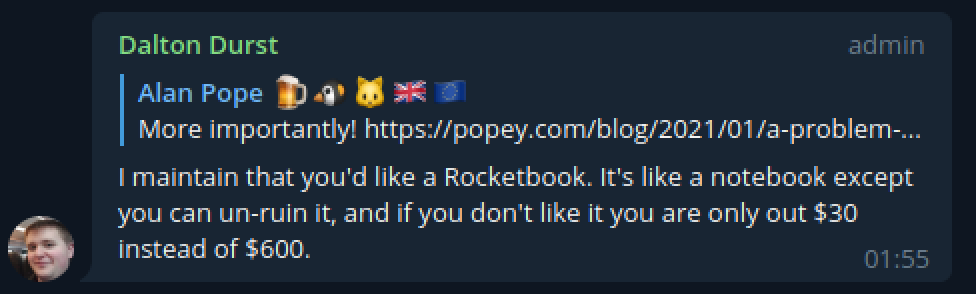
Put simply Rocketbooks are notepads with erasable not-quite-paper and not-quite-whiteboard material. During the conversation Dalton shared this photo of his books in use. As you can see they come in three sizes, and have differing patterns / lines pre-printed on them.
[Read More]
13th Twitter-versary
Posted on Sat, Jan 16, 2021 (Last modified on Sat, Mar 21, 2026)
| Alan Pope
I woke up this morning to a notification injected into my timeline in the Twitter app.
Apparently it’s my “Twitter anniversary” which I can “celebrate” by tweeting out a pre-made picture of the number 13. That’s too easy. Instead I recently downloaded my Twitter data. Let me be self-indulgent and take a look and see what happened over those 13 years.
For those who haven’t tried downloading their Twitter data, what you get is a browseable archive with a summary front page.
[Read More]
Distrowatch is Not a Measure of Popularity
Posted on Fri, Jan 15, 2021 (Last modified on Sat, Mar 21, 2026)
| Alan Pope
Here’s a fun blog post where I get possibly irrationally annoyed by people who use a web page incorrectly. Let me get this off my chest and then move on to better topics tomorrow.
Distrowatch is a popular website among Linux enthusiasts. The main page consists of reverse-chronological news articles of interest to Linux users. Often this consists of new stable and development release announcements, reviews and weekly roundups.
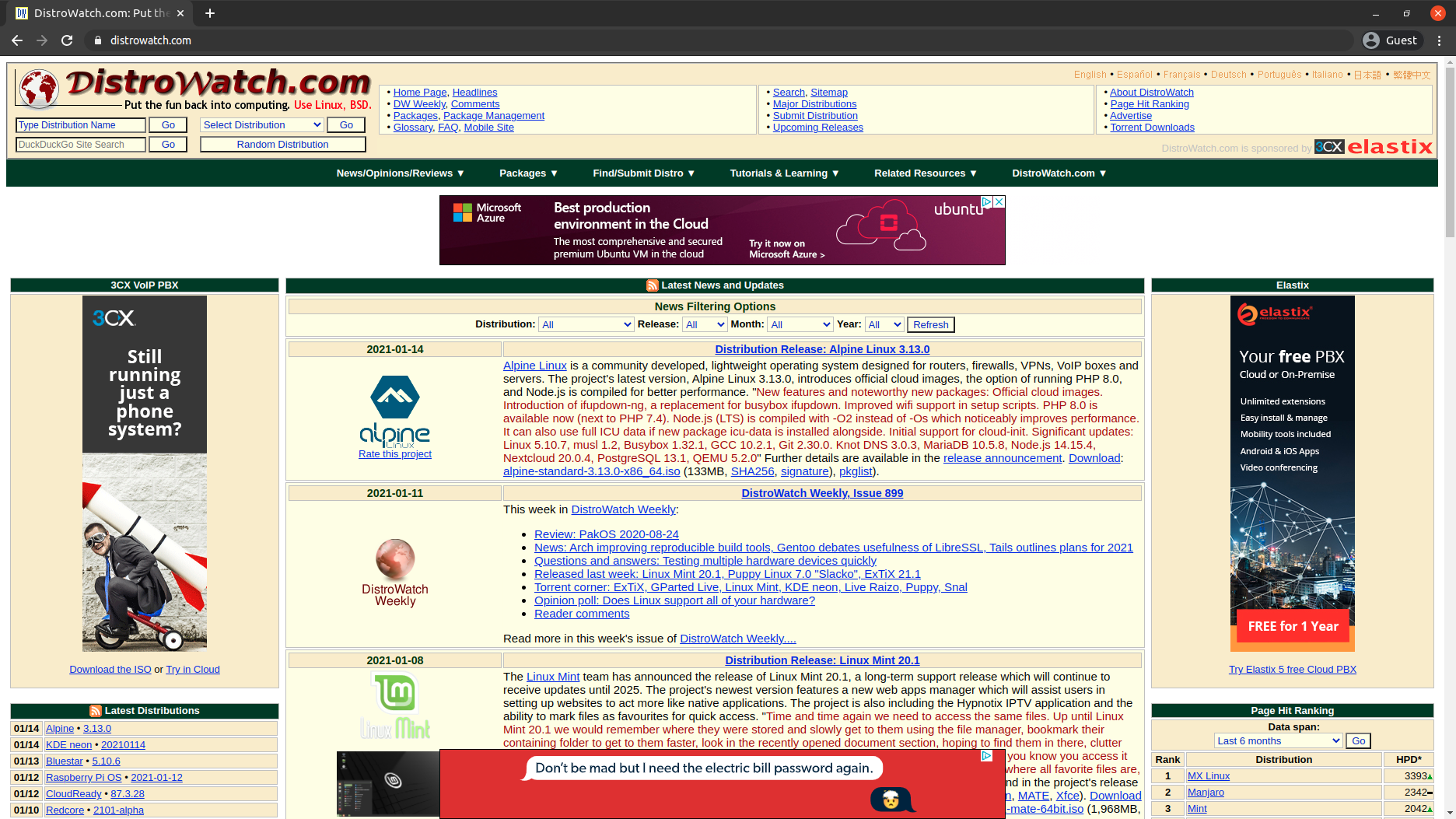
In addition, there are boxes surrounding the content highlighting the latest Linux distributions, podcasts, software packages and some advertising. Much of the non-advertising content is also served via RSS feeds so enthusiasts can keep up to date with the content. Finally there’s a large “Page Hit Ranking” on the right-side of the main content. This is the main focus of this blog post.
[Read More]
Breaking my Crowdfunding Hiatus
Posted on Thu, Jan 14, 2021 (Last modified on Sat, Mar 21, 2026)
| Alan Pope
Just days after blogging about My Crowdfunding Stats, I’ve broken my “no crowdfunding” streak of near 18-months by backing something small, but delightful!
Last night a tweet by Tom Brinton crossed my desk. Tom is creating a notebook in which every page is a procedurally generated portable dungeon crawler. The campaign is called “Tiny Paper Dungeons” and it runs until 2nd February 2021.
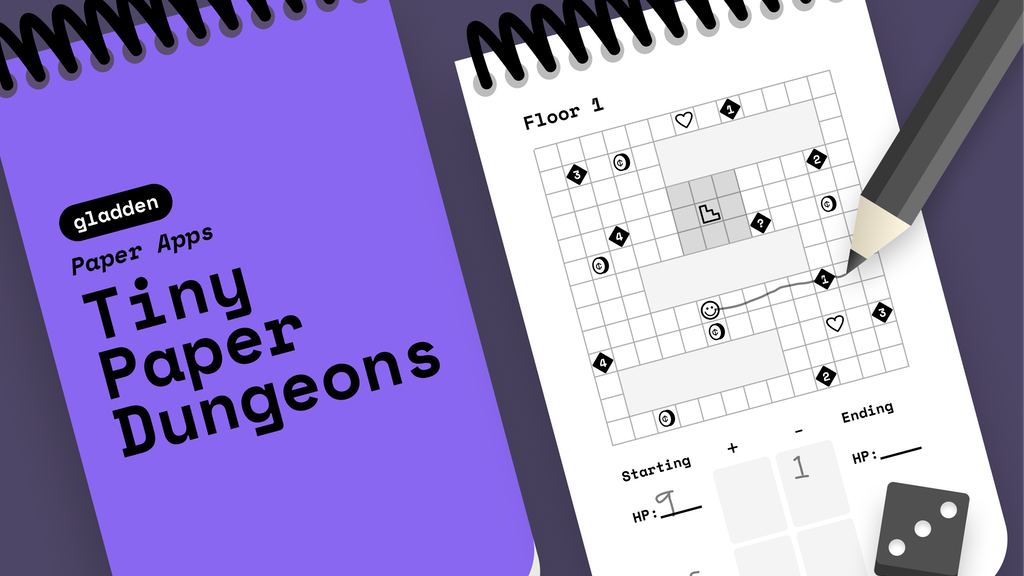
Tom has previously made a project in a similar vein called NUTRI-TRACK. Collectively these are “Paper Apps”, which I find engaging. Yes, I totally get that these are “just” pre-printed pads, I get it. But I love the whole concept of single purpose analog devices which drag us away from “smart” things now and then.
[Read More]
null
Posted on Wed, Jan 13, 2021 (Last modified on Sat, Mar 21, 2026)
| Alan Pope
I quite like to break things. While I’m not a QA or security professional, I have developed a knack for doing “stupid” things with software which causes it to malfunction. Some developer friends of mine have lamented that they didn’t show me software before they released it. Because I sometimes find annoying bugs immediately after they release.
Here’s some fun examples of pushing the boundaries of software, sometimes by doing things a little “out there”, beyond what the developer expected or tested.
[Read More]
Digital Hoarding: Ubuntu Mirror
Posted on Tue, Jan 12, 2021 (Last modified on Sat, Mar 21, 2026)
| Alan Pope
I have a bunch of Ubuntu machines on my local network at home. They all periodically need to check for updates then download & install them. Rather than have them all reach out to the official mirrors externally to my network, I decided to run my own mirror internally. This post is just a set of notes for anyone else who might be looking to do something similar.
I also do a lot of software building, and re-building, which pulls all kinds of random libraries, compilers and other packages from the archive. Having it local saves me repeatedly downloading from the ’net while the kids are on Netflix School Zoom classes.
[Read More]
Digital Hoarding: Gaming Edition
Posted on Mon, Jan 11, 2021 (Last modified on Sat, Mar 21, 2026)
| Alan Pope
Another in a series of “I have identified a problem here!”. I appear have quite a few video games. More than I can probably play in my time left on Earth. Let’s set aside all the retro games I have for a moment, and consider only the ones that run on my primary computer, a PC. To be clear, I’m only talking about ’native’ games.
Aside: I hate the word ’native’ in this context, because what’s native? A ZX Spectrum game running under an emulator isn’t native to the PC, is it? Shattered Pixel Dungeon is written in Java though, and that bytecode isn’t native to my Intel i7 CPU. Theme Hospital running under DOSBox isn’t native either, but wait, it’s DOS, so it is PC native. Does anyone even write video games in 80x86 assembler these days? :)
[Read More]
My Crowdfunding Stats
Posted on Sun, Jan 10, 2021 (Last modified on Sat, Mar 21, 2026)
| Alan Pope
While writing my Ouya post the other day, I was reminded of the various projects I’ve backed on crowdfunding sites over the years. Between May 2012 and August 2019 I helped fund 68 separate projects. Most for “beer money” (around a tenner) through “toy money” (up to fifty quid) up to “need to have a think about this money” (a hundred quid or so). The vast majority have been successful, and I’ve received my backer reward in a timely fashion.
[Read More]
Two Displays & Two Computers
Posted on Sat, Jan 9, 2021 (Last modified on Sat, Mar 21, 2026)
| Alan Pope
In my messy office I have a main desk I work at. I have two portait displays on a hefty, but inexpensive BONTEC Dual Monitor Stand (affiliate link), clamped to the back, to lift the monitors up off the desk. The monitors are 3-year-old, low-end 24" ASUS VS248HR (affiliate link) “Gaming Monitor’s” 🤣.
I recently bought a Raspberry Pi 400 which also sits on my desk for quick-release arm64-action! The problem I have had with other Pi’s is the spiders web of cables needed, and additional keyboard. So when the Pi 400 came out, with integral keyboard, and ports all aligned at the back, I snagged one.
[Read More]